Guides › The stash
How often to replace breast pump parts
The soft parts wear out months before they look worn, and you notice it in the milk long before you notice it in the part.
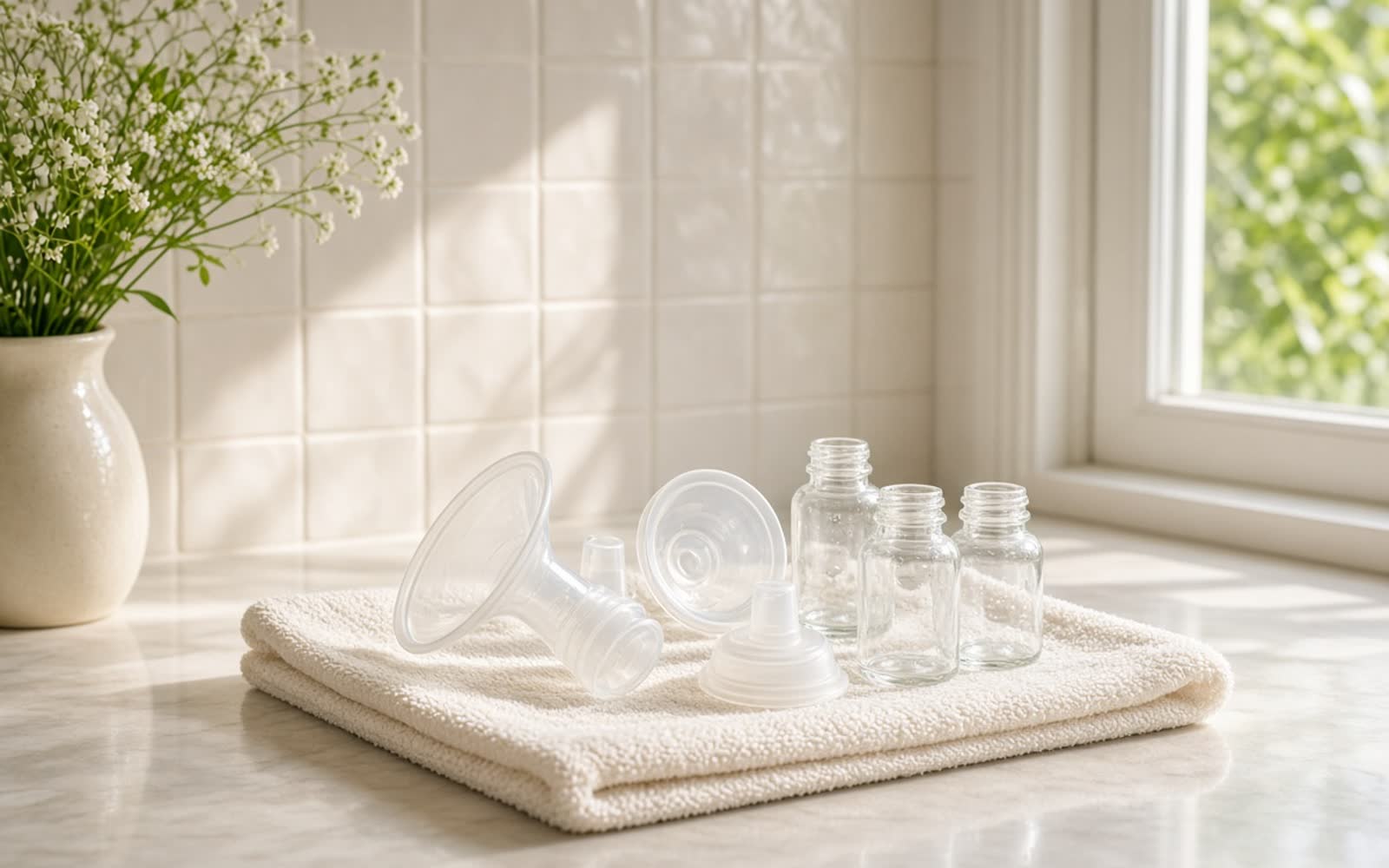
The short answer: valves and membranes are the parts that wear, and suction is how you find out. If a session is taking longer for the same amount of milk, change the valve before you start worrying about your supply. Spectra publishes intervals – roughly two months of heavy pumping for a duckbill – while Medela says change parts when they are damaged rather than on a clock. Check your own manual, then trust the symptom over the schedule.
Everything that touches milk is single-user, so none of it is worth buying second-hand at any price.
What actually wears
A pump is a motor and a set of soft parts, and the motor is almost never the problem. What ages is silicone: the thin pieces that flex thousands of times a session and get washed in hot water afterwards, day after day.
- Duckbill valves, or on older Medela kits the yellow valve and its thin white membrane. This is the part that fails first on nearly every pump, and it is also the cheapest thing in the box.
- Backflow protectors, if your pump has them. Spectra does. Medela pumps do not, which is why advice written for one brand often makes no sense for the other.
- Flanges, which last a long time but are done once they are scratched inside, cloudy or cracked. Worth re-checking the size occasionally as well, because nipples change over a feeding year and the size that fitted in month two may not be the size that fits in month ten.
- Connectors, seals and O-rings, the small rings that hold the assembly airtight. A perished seal loses suction exactly like a worn valve does and is easier to overlook.
- Tubing, which on a closed-system pump never meets milk and needs nothing routine. It comes out when there is moisture, cloudiness or mould inside it, when it has stretched loose at the ends, or when it cracks.
- Wearable pumps have their own smaller spouts, diaphragms and valves, and they tend to want changing more often than the equivalent parts on a mains pump, because everything in them is thinner.
A worn valve reads as a dropping supply
This is the reason the page exists. When a duckbill softens, it stops sealing cleanly on the return stroke, so the pump loses a little of its vacuum on every cycle. Nothing looks broken. What happens instead is that a session that used to take fifteen minutes takes twenty-five, and the bottle has less in it, and the obvious conclusion is that your supply is going.
It might be. But a valve costs a couple of pounds and a fortnight of worry costs rather more, so change the cheap part first and find out.
The signals, roughly in the order people notice them:
- Sessions getting longer for the same output, over weeks rather than days.
- Suction that feels soft at a setting that used to feel firm, or a pump you keep turning up.
- Milk that starts flowing later in the session than it used to.
- A valve whose slit sits open when it is lying flat and clean, or one that has gone cloudy, stiff, tacky or visibly stretched.
- Whistling, hissing or a change in the note of the motor, all of which mean air is getting in somewhere.
 Medela pump membrane tutorial
Tap to play – nothing loads from YouTube until you do
How often, by part
Manufacturers disagree, and they disagree for a reason: the parts are not the same shape and do not carry the same load. Use your own manual as the authority and this table as the shape of the thing.
| Part | Pumping 3+ times a day | Pumping 1 to 3 times a day | The real signal |
|---|---|---|---|
| Duckbill valves (Spectra's published guidance) | Every 2 months | Every 3 months | Longer sessions, softer suction |
| Valve membranes (the thin white discs on older kits) | Every 2 to 4 weeks | Every 2 months | Curling edges, any tear you can see |
| Backflow protectors (Spectra and similar) | Every 3 months | Every 6 months | A stretched or wrinkled membrane |
| Medela kits | No fixed interval published – Medela's position is to replace parts when they are damaged | Suction loss is still your cue | |
| Flanges, connectors, bottles | No routine schedule | Scratches, cracks, cloudiness, a size that no longer fits | |
| Tubing | No routine schedule on a closed system | Moisture, mould, stretch, cracks | |
Two things shorten the life of all of it. Heat is the main one: sterilising every single cycle, or a dishwasher, ages silicone faster than washing by hand and sanitising once a day. The other is a bottle brush pushed through a valve slit, which stretches the one dimension that has to stay tight. Wash valves in soapy water and let the water do the work.
What it costs, if you pump every day
Soft parts are cheap one at a time and add up over a year: a set of duckbills is a couple of pounds or dollars, membranes similar, and a full resupply of everything soft usually lands somewhere in the tens rather than the hundreds. Prices move, and a pack of six valves costs barely more than a pack of two.
The number worth doing is the other one. Say a tired valve is costing you 20 ml a session – a realistic, unremarkable amount – and you pump once a day. That is 600 ml a month. At the going rate of £1.20 to £3.50 per fl oz, the milk you did not collect is worth £21 to £51, against a part that cost two.
So if you are selling any of your surplus, replacement parts are the cheapest input you have, and running them past their life is the most expensive economy available to you. Keep the receipts either way, because if selling ever becomes regular for you, the parts are a cost of doing it.
One difference across the Atlantic: in the US a replacement-parts resupply is often covered by insurance on a schedule, and it is worth checking what yours allows before paying for anything. In the UK you buy them yourself.
Buying replacements
Three rules, and only one of them is about money.
- ⛔ Nothing second-hand. Valves, membranes, flanges, connectors, bottles and backflow protectors are single-user, and so is a personal pump. Milk residue and the moisture that comes with it are not things a rinse resolves, and the whole point of what we do here is that a buyer can trust how the milk was handled. Rental pumps are the exception, because they are built as closed systems with a fresh kit per mother.
- Generics are a fit question, not a safety question. Plenty of pumpers use them happily. A duckbill moulded a shade stiffer or softer than the original will not seal identically, so change one part at a time and watch the next couple of sessions. That way you know what caused what.
- Buy the multipack. The cost of a spare set is trivial next to the milk lost in the fortnight you spend wondering whether it is you.
We do not recommend particular brands here. When we have tested something, or a lactation consultant we work with has, we will say so and say how. Until then a list of product names would be worth nothing to you.
Common questions
How do I know if my pump parts need replacing?
Output tells you before appearance does. A session that takes longer for the same amount of milk, or suction that feels soft at a setting that used to be firm, is the signal. Cloudy, stiff, tacky or stretched silicone confirms it, but most parts stop working properly well before they look wrong.
How often should I replace duckbill valves?
Spectra's guidance is every two months above three sessions a day, every three months below that. Medela does not publish an interval and says to replace parts when damaged. Check your manual, and treat whatever it says as the backstop rather than the trigger.
Can I use cheap generic pump parts?
Usually yes, with one precaution: fit varies more than quality does. Change a single part at a time and watch your next couple of sessions, so a new valve that seals badly does not get blamed on your body.
Can I buy second-hand pump parts?
No, and this is the one firm answer on the page. Everything that milk touches or backs into is single-user, and that includes a whole second-hand personal pump. Rental pumps are built differently and come with a new kit each time.
My output dropped. Is it my pump or my supply?
Change the valve first, because it is the cheapest test available and worn valves are the commonest cause of a slow decline in someone who has changed nothing else. If fresh parts do not fix it within a few sessions, ring a helpline instead of buying more parts.
Does the tubing need replacing?
Not on a schedule, if your pump is a closed system, because milk never reaches it. It comes out when you see moisture or mould inside, when the ends have stretched loose, or when it cracks. Mould in tubing ends that length for good.