Guides › Human milk vs formula
Human milk vs formula: what you're actually paying for
We sell one of these and not the other – worth knowing before you read on. So this is the comparison written straight, including the parts that don't flatter us.
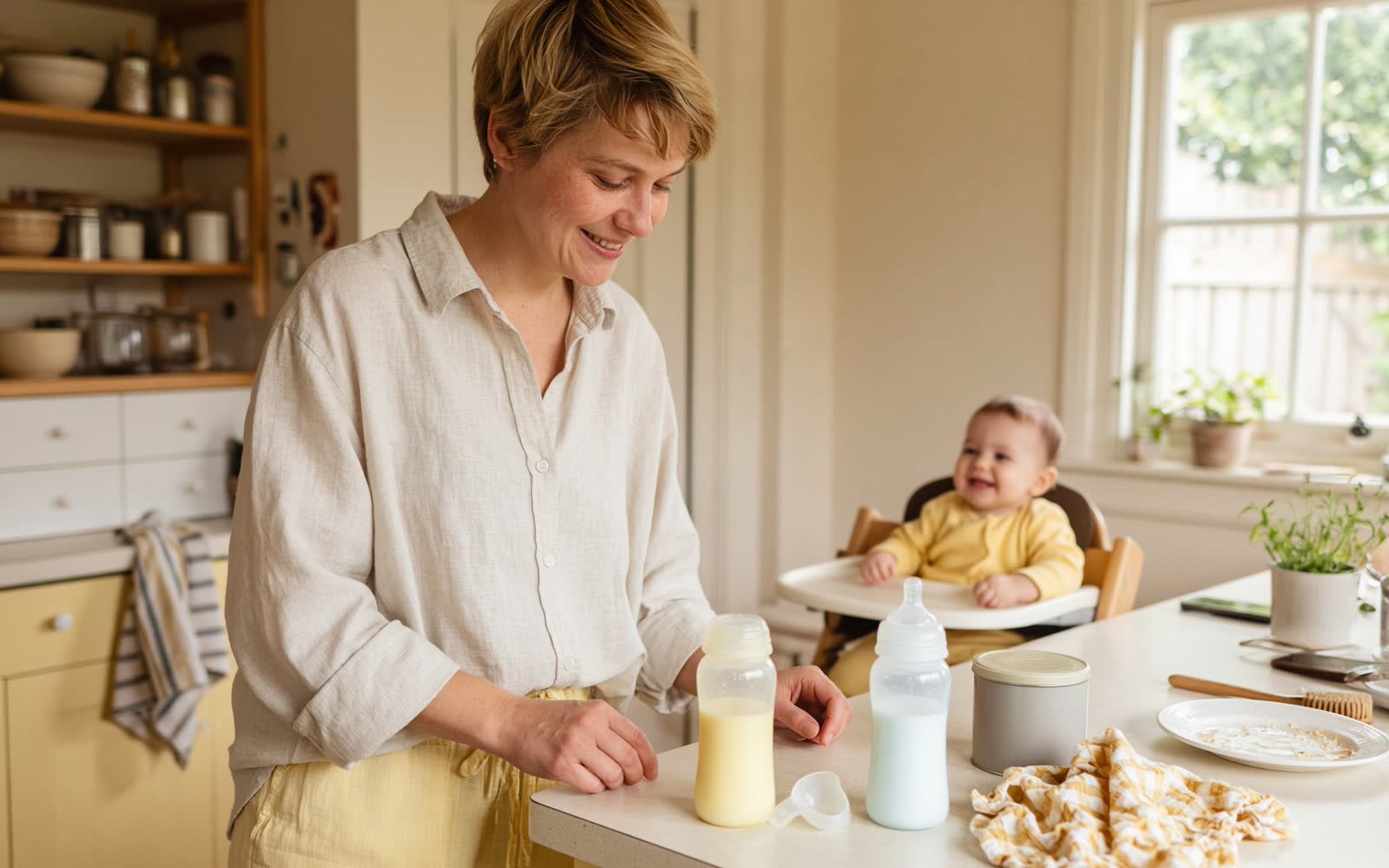
The short version: evolution optimised the recipe, not the water supply. Human milk is unimprovable in design and unprotected in purity. Formula is the inverse – its purity is monitored and legally bounded, and its design is frozen at whatever nutritional science currently knows how to add. Formula is nutritionally complete and safe. What it structurally cannot contain is the living, tailored part.
What formula cannot contain
Start by giving formula its due, because the honest case doesn't need it weakened. Formula is regulated to be nutritionally complete, it does the job it is designed to do, and it has kept babies alive and thriving for generations. Anyone telling you your baby is malnourished on formula is wrong.
The gap is bioactive rather than nutritional, and it comes in four parts:
- Antibodies written by one particular woman. A mother's milk carries immunoglobulins shaped by her own immunologic history – the specific things she has met and fought. No manufacturer can formulate that, because it is a record of one woman’s immune history rather than a recipe.
- Human milk oligosaccharides. Human milk contains roughly two hundred of these sugars, in a mix partly determined by the mother's own genetics. Formula contains one or two, synthesised. The research literature is blunt about this: extraction and synthesis techniques keep improving, but we are, in one review's words, "still a long way from replicating the full diversity and complexity of sugars in human milk". HMOs mostly do not feed the baby at all; they feed her gut bacteria and shape her immune development.
- Live cells, enzymes and hormones. Nothing alive survives manufacturing, so no tin will ever carry them.
- Everything nobody has characterised yet. This is the part we would emphasise if we were only allowed one. Formula can only contain what we have thought to put in it. Every year the literature describes another component of human milk and another thing it appears to do. A tin is limited by the state of knowledge in the year it was formulated; milk is not limited by anything.
That is the superiority argument, and it needs no attack on formula to land. It describes the limits of a manufactured product; it says nothing about the people who buy one.
The recipe, side by side
The same comparison as a table, so you can see where each one earns its keep. "Formula" here means standard infant formula; bought human milk between individuals is raw unless you pasteurise it at home.
| What's in it | Human milk | Infant formula |
|---|---|---|
| Calories, protein, fat | All there, and the mix shifts through a feed, through the day and across months. | All there, regulated to be complete, identical every scoop. |
| Vitamins and minerals | Present; vitamin D is the well-known low spot. | Added to regulated targets, vitamin D included. |
| Milk sugars (HMOs) | Roughly two hundred, the mix partly set by the mother's own genetics. They feed the baby's gut bacteria and shape immune development. | One or two, synthesised. |
| Antibodies | Written by one particular woman's immune history. | None. They cannot be manufactured. |
| Live cells, enzymes, hormones | Present in raw milk; pasteurising reduces them. | None survive manufacture. |
| Everything not yet characterised | Present and working, named or not. | Only what science has thought to add so far. |
| Purity | Unmonitored – it rests on the mother's diet, disclosure and handling. | Batch-tested and legally bounded. |
| What it costs | $1.50–4.50 an ounce bought – roughly $1,100–4,050 a month if it were every feed. | Roughly $100–150 a month. |
Read down the columns and the shape of the whole page appears: milk wins on design, formula wins on consistency, purity monitoring and price. Which is why the section on feeding both exists.
 Breastfeeding vs. Formula | Ask an Expert
Tap to play – nothing loads from YouTube until you do
The processing question
Infant formula is an ultra-processed food. The word is doing classification work, no insult intended – it is manufactured from refined and modified ingredients, which is what the term means. Human milk sits at the opposite end of the same scale, and remains the least processed food a human being can buy.
If your family has spent years steering away from ultra-processed food, that inversion is often what makes buying milk feel obvious instead of strange. It's a fair reason. It just isn't the same reason as "purer", which is the next section.
Contaminants, in both
This is where most articles pick a side and stop. We're going to do the whole thing, because you can look all of it up.
Formula. Consumer Reports tested 41 powdered formulas and found about half contained potentially harmful levels of at least one contaminant – arsenic, lead, BPA, acrylamide, PFAS among them. Advocacy testing has reported arsenic in a large majority of formulas, though that work has not been peer reviewed and is worth weighting accordingly. Regulators respond that heavy metals are environmental and cannot simply be removed from food, which is true and is also not very comforting.
Human milk. It carries what the mother has accumulated, and lactation is one of the routes by which a body offloads it. One US study found PFAS in 50 of 50 samples tested. Lead is the single most-studied contaminant in breast milk, across dozens of studies, with high concentrations reported in some regions, and a prospective cohort has linked lead in human milk to infants' language development. A risk assessment across the literature concluded that infant intake of arsenic, lead and mercury through breastfeeding is a health concern in most regions of the world.
So the tidy version some people want – industrial food is contaminated, natural food is clean – does not survive contact with the data. Both carry both. Human milk is at the top of a food chain, and a thirty-year exposure history concentrates into it. Evolution did not anticipate PFAS.
Two things are worth keeping from that, and they pull in opposite directions:
- Lead deserves more weight than PFAS. The lead evidence in infants is consistent, dose-dependent and points to no safe threshold. The PFAS picture in infants is real but heterogeneous, and systematic reviews disagree with each other. That asymmetry applies to both matrices, since lead is in both.
- The authorities have already weighed this. The CDC, ATSDR, the American Academy of Pediatrics and the WHO all conclude that the benefits of breastfeeding outweigh environmental contaminant exposure, and one review adds that this holds "especially since formula milk might contain higher levels of contaminants."
What a person can tell you that a tin can't
Now the part that is genuinely ours, and it falls straight out of the research above. What drives contaminant levels in human milk is no mystery: the mother's own diet and her exposure to smoke. Fish and seafood, particularly the large predatory kind, and first- and second-hand smoking come out repeatedly as the major determinants.
Those things are askable. They are on the disclosure sheet already, sitting next to caffeine and medications, and they are the reason that sheet is a food-safety instrument and not merely a courtesy. A seller who does not smoke, does not live with a smoker and does not eat swordfish twice a week can tell you so, and you can decide what that is worth.
You cannot ask a tin what it ate. That is the trade in one line: the industrial product is tested and bounded and anonymous, and the human one is untested and unbounded and can be asked questions. Neither is a guarantee.
We will not oversell this. A disclosure sheet is a self-report from someone with an incentive, which is exactly why it sits alongside identity verification, ratings from completed sales and optional screening instead of standing on its own. And we do not test milk. If we ever do, we will say precisely what the test proves.
What it costs, without the sales pitch
Formula runs roughly $100–150 a month for name-brand powder, less for own-brand, and $130–200 for organic. Bought human milk at 25–30 oz a day, 750–900 ml, and $1.50–4.50 an ounce is $1,100–4,050 a month.
That is eight to thirty times the price, and no amount of writing changes the arithmetic. So the sensible framing is not milk instead of formula, but how much of a baby's feeding you want to buy, which for most families is a share: the early months heavier, later months lighter, the rest formula. The adoptive and surrogacy families' page works through what a realistic month looks like.
One exception is worth knowing. Specialist hypoallergenic formula costs $250–450 a month in the US, and for a baby who reacts to standard formula, the gap narrows sharply – though bought human milk is still several times the price. ⚠ In the UK that comparison does not hold: hydrolysed and amino-acid formulas are on NHS prescription for diagnosed cow's milk allergy, so a UK family pays nothing. If this is your situation, the reaction itself is a question for your paediatrician first, and the allergy page has the part nobody mentions about donor diets.
Breast and bottle together: the combination the table points to
Bought milk is a premium food, and feeding a baby on nothing else is out of reach for most households. We would rather say that plainly than let the price quietly send people away – because the next thought is much better than the defeat it sounds like. Nothing in the table above arrives on an all-or-nothing basis. Every ounce of human milk a baby drinks carries the antibodies, the sugars and the living components with it, whatever else is in the day's other bottles. And every scoop of formula alongside it brings the things milk cannot promise: regulated completeness, monitored purity, and a grocery-shaped price.
So a mixed rota is not the budget version of proper feeding. It is a combination with real strengths on both sides – milk supplying what only milk can, formula making sure nothing is missing, and the household budget still standing at the end of the month. It is how most families who buy milk actually feed, and we would rather build for that honestly than pretend everyone can afford the purist version. And this comes from a site that earns nothing when you buy formula.
The right share is a money question first – the adoptive families' page works through a realistic month. And if you are nursing yourself and weighing a top-up, how to do that without unsettling your own supply is a conversation for an IBCLC, and the free helplines are here.
Where we stop, and one thing we will not say
We write about mechanics, logistics, money and law. We do not diagnose, we do not advise on medication, and we do not tell you what to feed your baby. Those questions belong with your paediatrician, health visitor or a lactation consultant, and the free helplines are listed here.
And the thing we will not say: that formula is bad, or that feeding it is a failure. It is a safe, regulated, carefully made food, and the overwhelming majority of families who buy human milk also use it. If you have arrived here after a hard few weeks of feeding, you are doing more research about your baby's food than most people ever do about their own. The ratio in your fridge is nobody else's business.
Common questions
Is human milk better than formula?
On nutrition, formula is designed to be complete and regulated to be so. The difference is the living, tailored part: antibodies from one woman's immune history, roughly two hundred oligosaccharides against a tin's one or two, live cells, enzymes. Formula can only contain what we have thought to add.
Does formula contain heavy metals?
Testing has found contaminants in formula – Consumer Reports found about half of 41 powdered formulas had potentially harmful levels of at least one, including arsenic and lead. Regulators point out that heavy metals are environmental and cannot be fully removed from any food.
Is breast milk free of contaminants?
No. It carries what the mother has accumulated: one study found PFAS in 50 of 50 samples, and lead is the most-studied contaminant in human milk. Health authorities still conclude the benefits of breastfeeding outweigh the risks.
Is buying milk worth it against formula prices?
Exclusively, rarely – it is eight to thirty times the cost. As a share of feeds, many families think so. Against specialist hypoallergenic formula at $250–450 a month, the gap is far narrower.
Is mixing human milk and formula OK?
It is what most buying families do. The living components in human milk arrive with every ounce rather than on an all-or-nothing basis, and formula alongside guarantees complete nutrition at a manageable cost – the case for the combination is above. How to divide feeds for your own baby, especially if you are nursing too, is a question for your paediatrician or an IBCLC.
Is formula bad for my baby?
No, and we are not going to pretend otherwise to sell milk. Babies fed formula thrive. Most of our buyers use both.
Should I buy milk or ask a milk bank?
Ask a bank first, always, especially if your baby is early or unwell. The four routes, compared, are here.