Guides › Pasteurising at home
How to pasteurize breast milk at home
Milk banks pasteurise every ounce they send out, and the home version of that safety step needs nothing but a pan, a glass jar and attention. This is the flash-heating method from the medical literature – with the honest list of what heat can do, what it costs, and what it can never fix.
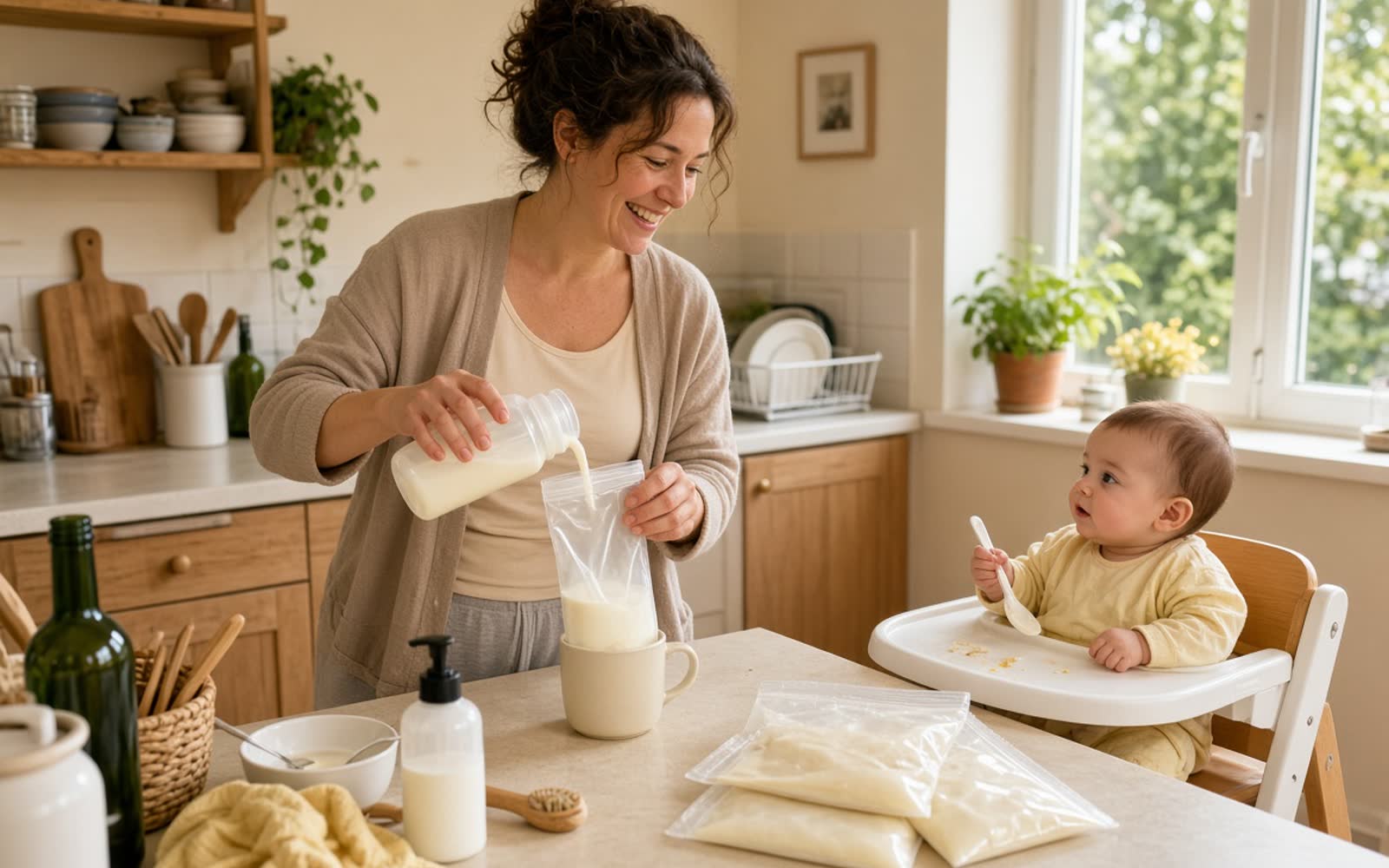
The short answer: stand an open glass jar of milk in a small pan of water, heat until the water reaches a full rolling boil, lift the jar out at once, cool it fast and refrigerate. That is flash-heating – the home pasteurisation method studied in the medical literature and described by the Academy of Breastfeeding Medicine for shared milk. It kills the bacteria and viruses that worry people most, at a real but modest cost to some of the milk's living components. What it cannot do is undo dishonesty: no heat removes alcohol, medication or added cow's milk.
Why heat milk at all
Human milk is a raw food, and everything on this site about careful buying flows from that fact. Milk banks answer it industrially: every ounce they dispense is pasteurised and batch-tested before it reaches a baby. A family feeding bought milk at home has a version of the same move available, and it is far simpler than it sounds.
The methods on this page were not invented for marketplaces. Flash-heating was developed and studied so that mothers with HIV in places without safe formula could feed their own expressed milk safely – a far harder test than anything a careful buyer faces – and the research found it inactivated the virus and eliminated the bacteria spiked into test samples, while leaving the milk's vitamins essentially intact.
One thing said plainly, because trust is built by including it: the Academy of Breastfeeding Medicine's position statement that describes home flash-heating also strongly discourages buying milk over the internet at all. We know, and we have answered that argument in full – the short version is that the alarming studies measured anonymous classifieds, not careful sellers. Their caution makes the method more worth borrowing, not less: it exists precisely for milk from outside your own body, handled by someone else.
Flash-heating, step by step
- Start clean. Washed hands, and a clean, heat-resistant glass jar – never plastic. Work in batches of 50 to 150 ml, the amounts the studies validated; bigger volumes heat unevenly.
- Set up the water bath. Stand the jar, uncovered, in a small pan of water, with the water level comfortably above the milk level inside the jar. The studies used about 450 ml of water in a one-litre pan around a standard jar.
- Heat on high until the water reaches a full rolling boil. Large, vigorous, unmissable bubbles – not the first small ones whispering at the edge of the pan.
- The moment it boils, lift the jar out. Oven glove, straight out, no lingering. Flash-heating works because the milk passes through pasteurising temperatures while the water climbs, and comes out before it cooks. Never leave the jar in boiling water, and never boil milk directly in a pan.
- Cool it fast. Lid on, jar standing in cold water, then into the fridge.
- Treat it like thawed milk from here. Fridge, used within 24 hours, never refrozen – the clocks are here.
That is the whole method. Batch after batch is fine; label what you have heated so it never gets mistaken for raw stock.
 Safe & Simple: How to Pasteurize Breast Milk at Home
Tap to play – nothing loads from YouTube until you do
The Pretoria variant, for a gentler evening
The second studied method, named for the city where it was trialled, flips the order: bring the pan of water to a boil first, take it off the heat, then stand the covered jar of milk in the hot water for 20 minutes before cooling. No watching for the exact moment of the boil, at the price of a longer soak. In the head-to-head study both methods eliminated the bacteria spiked into samples; flash-heating had the edge on viral inactivation and kept slightly more of the milk's antibacterial activity.
| Method | How it works | Where it comes from |
|---|---|---|
| Flash-heating | Open jar in a water bath, heated until the water reaches a rolling boil, then removed at once | Studied for home use; the method the ABM describes for shared milk |
| Pretoria | Water boiled first and taken off the heat; covered jar stands in it for 20 minutes | Studied alongside flash-heating as a low-equipment home method |
| Holder | 62.5°C held for exactly 30 minutes in calibrated equipment, then rapid cooling | The milk-bank standard, paired with donor screening and batch testing |
What milk banks do, and why theirs is still the gold standard
Banks use the Holder method – 62.5°C held for 30 minutes in purpose-built pasteurisers, followed by rapid cooling, with donor screening before the milk arrives and microbiological testing after it is treated. A home water bath approximates the germ-kill; it does not replicate the quality system wrapped around it. That is one more reason bank milk comes first for premature and unwell babies, and it is not a knock on the kitchen version – the kitchen version exists for healthy babies whose milk was never going to pass through a bank.
What heat costs the milk
Pasteurisation is a trade, and an honest page prices both sides. What survives well: the food itself – fats, proteins, calories – and the vitamins, where the flash-heating studies found no significant losses. What is reduced: a portion of the living components, including some of the antibodies, which is the ABM's own caveat about heat-treating shared milk. You are spending some immune proteins to buy certainty about bacteria and viruses.
Whether that trade is right is genuinely the buyer's call. Milk from a screened seller you have come to trust, moved on an unbroken cold chain, is the case for keeping it raw. Any doubt at all is the case for the pan. Either way, make it a decision, not a default.
What no heat can fix
Heat kills microbes. That is the entire list. It does not remove alcohol, nicotine, THC or medication – those either are or are not in the milk, which is why a seller's disclosure sheet matters more than anything you do at the stove. It does not dilute out added cow's milk or water; dishonesty passes through a water bath untouched. And it cannot fully undo earlier bad handling: some bacterial toxins formed while milk sits warm – the staphylococcal ones are the textbook case – survive boiling outright, so milk that spent an afternoon on a porch is not rescued by any pan.
Which puts pasteurisation in its correct place: the second line of defence, behind an honest seller and an unbroken cold chain, and comfortably ahead of hope.
Common questions
Can I just boil breast milk to make it safe?
Don't boil the milk itself. Flash-heating takes it through pasteurising temperatures while the water climbs to the boil, then gets it out before it cooks – direct boiling costs far more of the milk's value for no extra safety. And a microwave is never suitable: uneven heat, hot spots, and no way to know what any of the milk reached.
Does pasteurising destroy the nutrients?
The food value survives well – no significant vitamin losses in the flash-heating studies, fats and proteins intact. A portion of the living components is reduced, antibodies among them. That is the deliberate trade.
Will it make milk bought online safe?
It closes the microbe half of the risk – the half the alarming studies measured. It cannot fix a dishonest description, which is why who you buy from still matters more than what you do in the kitchen.
Do milk banks pasteurise?
Every ounce – Holder method, 62.5°C for 30 minutes, rapid cooling, batch testing. Home methods approximate the germ-kill, not the whole quality system.
How long does flash-heated milk keep?
Treat it like thawed milk: fridge, 24 hours, never refrozen.
Sources
- Academy of Breastfeeding Medicine – 2017 position statement on informal milk sharing – the home flash-heating instructions and the caveat on reduced components
- Israel-Ballard et al. – viral, nutritional and bacterial safety of flash-heated and Pretoria-pasteurised breast milk (JAIDS) – the head-to-head study of both home methods
- The effect of flash-heat pasteurisation on immune components of human milk (PMC)
- NICE clinical guideline 93 – donor milk banks – the Holder standard: 62.5°C for 30 minutes with rapid cooling
- Journal of Dairy Science – effect of heat treatment on staphylococcal enterotoxins in milk – why toxins from earlier mishandling survive pasteurisation