Guides › The surplus
Milk bank, sharing or selling: how to choose
Three doors out of the same freezer, and a lot of quiet guilt attached to picking the wrong one. Here is what each actually asks of you, what it pays, and where your milk ends up.
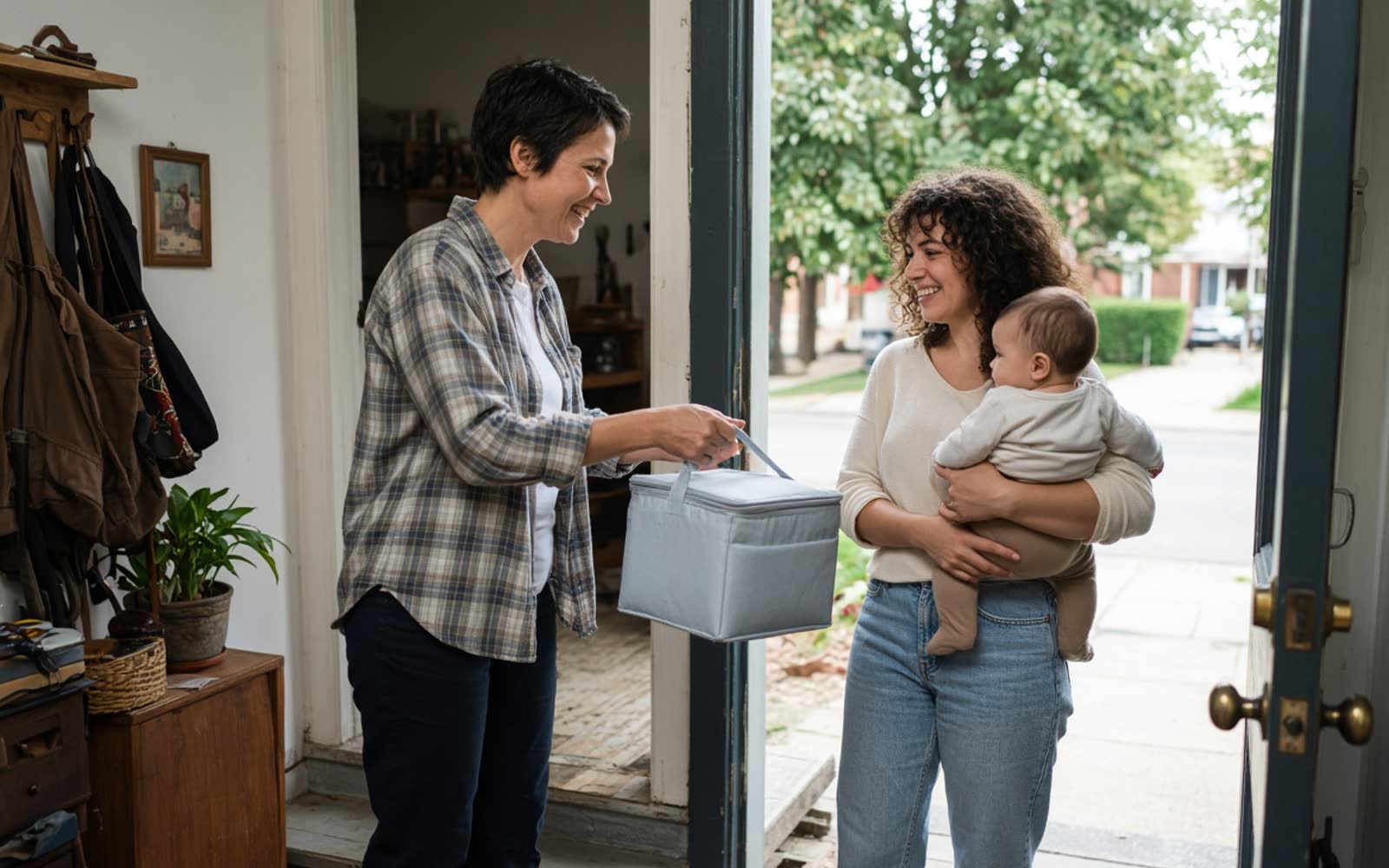
The short answer: if a milk bank near you can take your milk, that's the highest use of it, and it's unpaid. If they can't – too little, too old, the wrong medication history, no bank within reach – then sharing and selling are both honest options, and neither one takes anything from a sick baby.
Most of the guilt in this decision comes from a scarcity story that the milk banks' own numbers no longer support.
The three at a glance
| Route | What you're paid | Who gets your milk | What it asks of you |
|---|---|---|---|
| Milk bank | Nothing, at any non-profit bank in the UK or US. In the US, for-profit programmes pay around $1.20 an ounce. | Premature and medically fragile babies in neonatal units, plus some outpatients at home. | A health questionnaire, a free blood screen, and meeting their criteria on volume, milk age and medication. |
| Sharing | Nothing. Some families cover your bags and postage. | Another family directly, usually local, usually a healthy baby. | Honesty between two people, and your own time arranging it. |
| Selling | Typically $1.50–4.50 an ounce, about £1.20–£3.50 per fl oz. | Parents who can't produce enough, adoptive and surrogacy families, sometimes adult buyers. | Dated bags, an honest disclosure sheet, packing and posting. In the UK, a free council registration. |
Milk banks: the highest use, if they can take it
We say this first on every page where the question comes up, and we mean it. Banked donor milk goes to babies born far too early, for whom it sits closer to medicine than to food. If a bank near you can use your freezer, that is where it should go.
How it works: a phone call, a health questionnaire, a free blood screen, then collection or courier. The bank pasteurises, tests and distributes. In the UK, UKAMB lists the UK's banks, including one service covering all of Scotland. In North America, HMBANA lists thirty-one.
What you're paid: nothing, and that's by design – non-profit banks don't compensate donors in either country. Worth knowing, though: the milk isn't free at the other end. UK families are never charged, because the NHS and charities carry the cost. American hospitals and outpatient families pay a processing fee of roughly $3.50 to $5 an ounce, which is more than peer-sold milk usually costs. Money moves through milk banking; it just doesn't move to the mother.
Why they say no. Volume below their minimum, milk older than their limit, a baby past a certain age, medications or travel that trigger a deferral, or no bank or depot within reach of your car. Every rule is right for feeding a one-kilo baby, and not one of them is a verdict on your milk. Criteria vary bank to bank, so ask rather than assume you don't qualify.
In the US there's also a paid lane. Prolacta's donor programme pays $1.20 an ounce, about $4 per 100 ml, or routes $1.10 to charity if you'd rather; Medolac's Mothers Milk Cooperative pays $1 an ounce. Both feed clinical supply chains rather than families. It's a legitimate route, it pays less than peer selling, and it asks for the same screening a bank does.
Sharing: fastest, free, entirely on trust
Informal milk sharing is old and widespread, mostly organised through community groups where donation is the whole culture. It moves milk quickly, it costs nothing, and it often lands with a family having a hard month. If your freezer needs emptying this week, this is the route that can actually do that.
Two rules of the road. Those groups are for donation – posting anything for sale in them breaks their rules and, more to the point, it's rude. And sharing skips the screening and pasteurisation a bank does, so safety rests entirely on honesty between two people: health history, medication, alcohol, how the milk was stored and how old it is. That's what a disclosure sheet is for, whether or not any money changes hands.
 The Truth About Milk Sharing
Tap to play – nothing loads from YouTube until you do
Selling: the option with our name on it
Our interest is on the table – we're building a marketplace, so read this section knowing who wrote it.
Selling your own milk is legal in the UK and the US, and peer-sold milk typically fetches $1.50 to $4.50 an ounce, about £1.20 to £3.50 per fl oz. For a mother with a real surplus that's grocery money every week – work out what yours comes to – and what moves the number is mostly dates, honesty and consistency. In the UK, anyone selling regularly registers as a food business with their council: free, twenty minutes, and nobody can refuse you. In the US there's nothing to register.
What people underestimate is that it's a small logistics job rather than a transaction. Frozen solid, packed tight, posted early in the week, tracked. What people overestimate is the awkwardness: the good buyers are careful people with questions about dates and storage, and they get to the point. If the idea itself sits oddly with you, the essay on why it feels weird is worth ten minutes.
Does selling take milk from sick babies?
This is the question underneath the other three, so here it is straight. The worry assumes donor milk is scarce at the neonatal unit, and that a bag sold is a bag a premature baby didn't get.
The milk banks' own reporting doesn't describe that world any more. HMBANA, the non-profit network, dispensed a record 13 million ounces in 2025, about 385,000 litres, up 12% on the year before. Donor milk is available in 92% of Level III neonatal units and every Level IV unit. Around a quarter of its 2024 volume went to outpatients as surplus, and the association states plainly that it is confident of meeting demand now and in the future.
So: try the bank first, genuinely. If they can take your milk, give it to them and feel good about it. If they can't – and for most mothers with a freezer full of six-month-old milk, they can't – then selling it takes nothing from anyone, and pouring it away helps nobody at all.
Common questions
Do milk banks pay for breast milk?
Non-profit banks in both countries pay nothing. In the US, for-profit programmes do: Prolacta pays $1.20 an ounce, Medolac's Mothers Milk Cooperative pays $1 an ounce. In the UK there is no paid donation channel at all, which is why a British mother with a full freezer has no route to money except selling it herself.
Can I donate some and sell the rest?
Yes, and plenty of mothers do. Banks ask for a volume commitment rather than everything you produce. Meet their minimum, keep what your own baby needs, and the rest is yours to sell, share or keep.
What if there's no milk bank near me?
Ask anyway – several banks arrange couriers, and some run local depots that aren't obvious from the website. If the answer is still no, that's a logistics fact rather than a judgement, and sharing or selling are what's left.
Is bank milk safer than peer milk?
Pasteurised, screened bank milk is the more controlled product, and for a one-kilo baby that control is the whole point. For a healthy term baby at home, the honest comparison is different: safety comes down to handling and disclosure, which is the study everyone quotes, read properly. Pasteurisation also removes some of the live components that make raw milk what it is, which is why some buyers specifically want unpasteurised milk.
Which route is quickest to empty a freezer?
Sharing, usually within days. Selling takes a little longer because of packing and posting. A milk bank is the slowest to start, since screening takes a few weeks – worth beginning early if you think you'll qualify.